
Last Updated on July 21, 2026 by Admin
Obuasi Municipality is approaching a defining moment in its urban development journey, with population projections indicating that nearly 190,000 people could be living within its boundaries by 2045. While the municipality continues to attract residents because of its economic opportunities and strategic importance, planners warn that the pace of growth must be matched by deliberate planning, responsible land management, and stronger collaboration among traditional authorities, landowners, developers, and government institutions.
The projections, contained in the Municipality’s emerging Structure Plan developed with support from the German Agency for International Cooperation (GIZ), estimate that Obuasi’s population will rise from 115,150 in 2025 to 188,699 by 2045—an increase of almost 64 percent in just two decades.
Unlike the population, however, the municipality’s land area will not expand. Obuasi will continue to occupy approximately 109 square kilometres, with only about 87.2 square kilometres currently developed, making efficient land management one of the municipality’s biggest challenges.
Planning Ahead Instead of Catching Up
The projections were presented during a GIZ-supported stakeholder workshop on the Obuasi Municipal Structure Plan, where planners, Assembly Members, traditional authorities, Unit Committee members, government agencies, and development partners deliberated on how to prepare the municipality for future growth.
Officials explained that the Structure Plan is intended to move Obuasi away from reactive development toward proactive planning by identifying future residential, commercial, industrial, institutional and recreational zones before uncontrolled development takes place.
The plan also seeks to protect environmentally sensitive areas, preserve natural waterways, improve transportation networks, and provide clear guidance for future Local Plans that will regulate physical development across the municipality.
Housing and Public Services Under Increasing Pressure
The demographic projections suggest that demand for housing will continue to rise sharply over the next twenty years.
Housing density is expected to increase from 199.4 housing units per square kilometre to 326.7 units per square kilometre by 2045, while the average residential plot size remains unchanged at 80 feet by 80 feet.
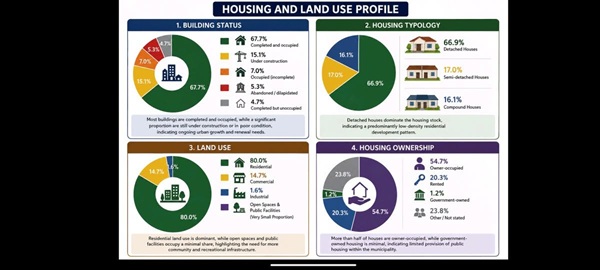
Current housing statistics already reflect growing pressure. The municipality has 17,384 houses, with an average household size of 6.62 persons and 2.8 persons occupying each room.
Social infrastructure faces similar challenges.
Although Obuasi has 236 educational institutions, only three Senior High Schools and one tertiary institution currently serve the municipality. Healthcare services are provided through seven hospitals and seven health centres, facilities that will require significant expansion if they are to keep pace with the projected population growth.
Chiefs and Landowners Have a Critical Role
One of the key messages emerging from the GIZ workshop was that successful implementation of the Structure Plan will depend heavily on the active involvement of traditional authorities and customary landowners.
With a significant proportion of land in Obuasi under customary ownership, planners stressed that chiefs and family heads occupy a strategic position in shaping the municipality’s future.
They were encouraged to:
-
Align land allocations with the approved Structure Plan and future Local Plans.
-
Protect wetlands, waterways, forests and other environmentally sensitive areas from encroachment.
-
Discourage indiscriminate land sales that lead to unplanned settlements.
-
Reserve adequate land for schools, health facilities, markets, roads, parks and other public infrastructure before allocating land for private development.
-
Collaborate closely with the Municipal Assembly to ensure that developments conform to planning regulations.
Participants noted that decisions taken by traditional authorities today will have lasting consequences for future generations.
Developers Must Build Responsibly
The workshop also underscored the responsibility of private developers and property owners.
Municipal planners urged developers to obtain planning permits before commencing construction, respect approved land-use zoning, and avoid building within waterways, flood-prone areas and designated road reservations.
Officials cautioned that failure to enforce planning regulations could increase flooding, traffic congestion, sanitation challenges and the cost of providing essential public services.
The Assembly’s Way Forward
To accommodate future growth while preserving the municipality’s environmental integrity, the Obuasi Municipal Assembly outlined several strategic priorities under the Structure Plan.
These include:
-
Preparing detailed Local Plans to guide development in every growth area.
-
Strengthening enforcement of physical planning and building regulations.
-
Protecting green spaces, wetlands and natural drainage channels.
-
Expanding road, drainage, water and sanitation infrastructure ahead of population growth.
-
Promoting mixed-use and higher-density developments in appropriate locations.
-
Improving public transport connectivity and access to social services.
-
Increasing public education on sustainable land use and environmental conservation.
-
Strengthening collaboration between the
Assembly, traditional authorities, utility providers, developers and residents.
Officials explained that the success of the Structure Plan will depend not only on government action but also on the willingness of all stakeholders to embrace coordinated planning and responsible land management.
A Shared Responsibility for Obuasi’s Future
As Obuasi prepares for nearly 190,000 residents by 2045, stakeholders at the GIZ workshop agreed that the municipality still has an opportunity to shape its future before rapid urbanisation overtakes available infrastructure.
Rather than allowing growth to occur haphazardly, participants emphasised that this is the time to make deliberate decisions that balance economic development with environmental protection, orderly land use and improved quality of life.
For chiefs, landowners, developers and residents alike, the message from the workshop was clear: the future of Obuasi will not be determined by population growth alone, but by the planning decisions made today.